Description
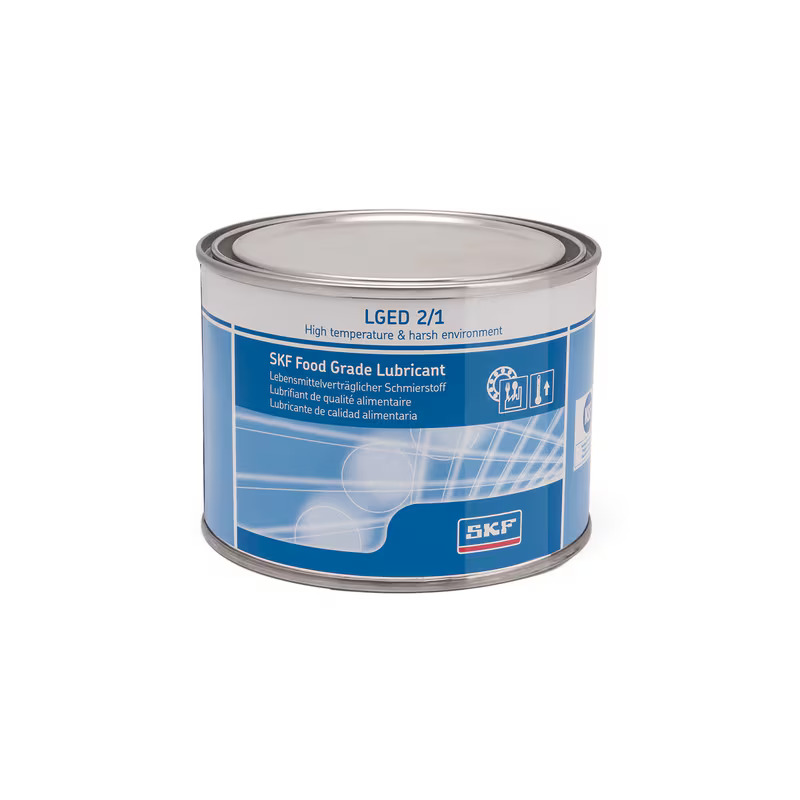
SKF LGED 2 is a food-grade, synthetic fluorinated oil-based grease with a PTFE thickener, certified by NSF Category H1. It is suitable for use at extremely high temperatures from 180°C (392°F) to 240°C (464°F) and/or in aggressive operating environments, such as those exposed to acids/alkalis, vacuum, oxygen, etc.
Technical characteristics and advantages
- Excellent oxidation stability
- Very low evaporation losses at high temperatures
- Good corrosion protection
- Long-term performance in aggressive environments, as well as in environments containing highly purified gaseous oxygen and hexane
- NSF H1 Certified
Application areas
- Bakery equipment and brick production
- Glass industry
- Furnace cars
- Tension rollers for copying machines
- Waffle ovens
- Textile dryers
- Film tensioners
- High temperature fans
- Vacuum pumps
| Capacity of the container | Designation |
| 1 kg canister | LGED 2/1 |
| Designation | LGED 2/(tank volume) | |
| Code according to DIN 51825 | KFK2U-30 | |
| NLGI consistency class | 2 | |
| Thickener | PTFE | |
| Color | Cream | |
| Base oil type | PFPE | |
| Operating temperature range | from −30 to +240 °C (from −22 to +464 °F) | |
| Dropping point according to DIN ISO 2176 | >300 °C (>570 °F) | |
| Base oil viscosity | 40 °C, mm2/With | 460 |
| 100 °C, mm2/With | 42 | |
| Penetration according to DIN ISO 2137 | 60 dives, 10-1 mm | 265–295 |
| 100,000 dives, 10-1 mm | 271* | |
| Corrosion protection | SKF Emcor: ISO 11007 standard | 0–0 * |
| Anti-seize properties | Four-ball test, welding load according to DIN 51350/4, N | min. 8000 |
| Water resistance | to DIN 51 807/1, 3 h at 90 °C | max 1 |
| Copper corrosion | ISO 2160 | max 1 at 100°C (210°F) |
| Service life of rolling bearing greases | L50 life test on R0F machine at 10,000 rpm, h | >700, at 220 °C (430 °F) |
| Evaporation losses | 6 weeks at 200°C, % weight loss | <3.5 % |
| Density at 20 °C, g/cm3 | 1,96 | |
| Shelf life | 2 years | |
| NSF Reg. No. | 156010 | |
| * Typical value | ||
Note: The density of LGED 2 is approximately 1.9 g/cm3. This value is twice the average density of standard bearing grease.