
DAFO was founded in Sweden.

100 years in the fire extinguishing market.
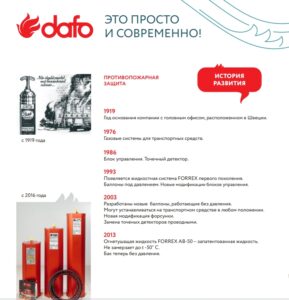
1919 – the company was founded.
1976 – DAFO becomes one of the pioneers
in the creation of fire extinguishing systems for vehicles.
Quality control systems ISO 9001 and ISO 14000.
Certified in Russia.
Today the company is a leader in the development
and the introduction of new methods and technologies to prevent
failure of equipment due to fire.
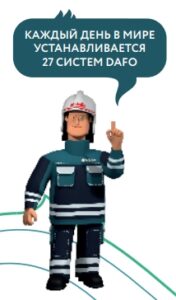
EVERY YEAR THE NUMBER OF FIRES ON ROADS AND PERMANENTLY USED EQUIPMENT IS INCREASING
THE PREREQUISITES FOR SUCH FIRES ARE VARIOUS:
- extreme working conditions;
- contamination of units with fuels and lubricants;
- accumulation of flammable materials and contaminants associated with operation in the engine compartment.
This and many other things can lead to overheating of the units and, ultimately, to fire.
Unfortunately, such an incident often leads to major repairs and/or replacement of hard-to-reach and expensive parts. The result is extended equipment downtime and potential loss of business.
But the worst that can happen is injury or even loss of life. As owners or operators of complex and expensive equipment, you have a vested interest in minimizing such risks, thereby reliably protecting your business and the lives of your employees.
It is for you and your peace of mind that the DAFO automatic fire extinguishing systems were created.
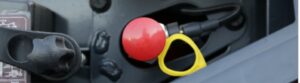
DAFO SYSTEM COMPONENTS
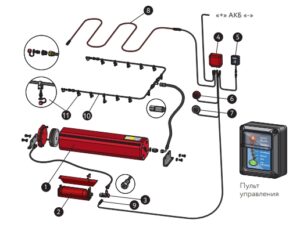
When the temperature rises, a fire may occur in the protected space. The wire reacts to the fire.
linear detection (detector) (8), which transmits a signal to the control unit (4). The control unit (4) transmits a signal to the pyropatroker (9),
which activates the trigger (3) on the nitrogen cylinder (2). At the same time, the alarm indicator light on the control panel (5) lights up.
and the sound (7) and light (6) signals are triggered. Gas from the nitrogen cylinder (2) is supplied to the container with the fire extinguishing agent.
FORREX (1), activating the piston, which pushes into the distribution pipeline (10)
The fire extinguishing agent is then sprayed through nozzles (11), covering the protected surfaces and space.